happy 250th birthday America! Here’s a little American history, with a little help from Keith, Retrobot David, and some results from AI to help guide us. Below are the exact notes from AI, although Keith adds in a few points he felt was missing, and challenges a few points that the AI supplied.
Introduction: The Collision of Worlds (3–5 Minutes)
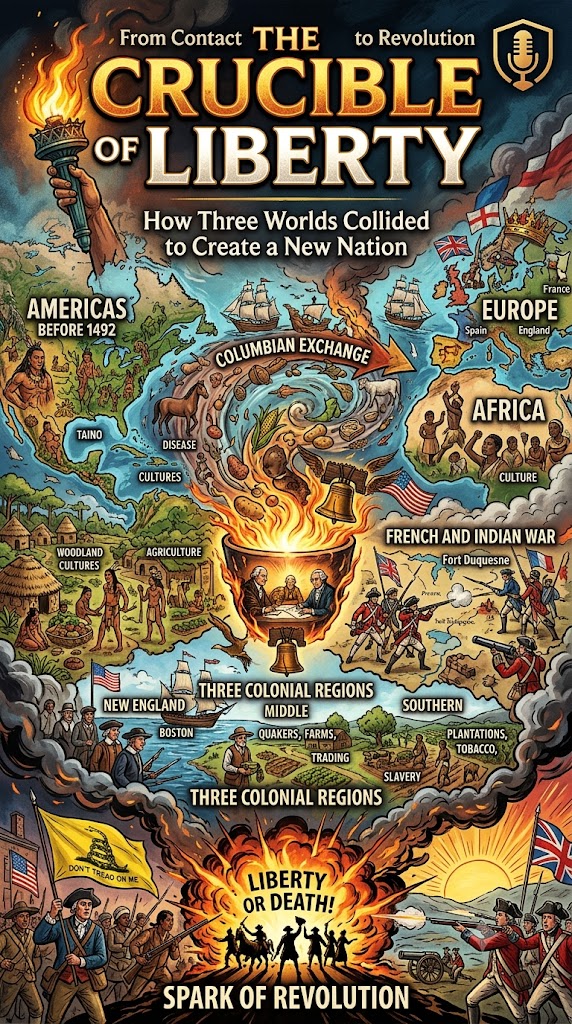
1: Title: The Crucible of Liberty: From Contact to Revolution
• Subtitle: How Three Worlds Collided to Create a New Nation
2: The Americas Before 1492
• A diverse continent: over 50 million Indigenous people.
• Roughly the population of Texas in New York combined.
• Highly sophisticated societies (e.g., Cahokia, the Iroquois Confederacy).
• Complex trade networks and diverse ecosystems.
Spoken Script:
Today, we are going to look at a pivotal chapter in human history: the story of how a vast, diverse continent transformed into the birthplace of the United States.
But our story doesn’t begin in a vacuum. Long before any European ship spotted these shores, the Americas were home to millions of people. From the advanced agricultural networks of the Mississippian cultures to the democratic political structures of the Iroquois Confederacy, this was not an ’empty wilderness.’ It was a thriving, complex world. Understanding this is vital, because what happens next is not just a story of discovery, but a story of dramatic collision.”
Act I: Contact and Convergence (1492–1607)
Suggested Presentation Time: 7–8 Minutes
3: 1492 & The Columbian Exchange
• Christopher Columbus’s arrival and the Spanish Empire.
• The Columbian Exchange: The global transfer of goods and culture.
• Goods to Europe: Corn, potatoes, tobacco.
• Goods to Americas: Horses, livestock, wheat.
4: The Devastating Toll
• The introduction of Old World diseases (smallpox, influenza).
• Up to 90% mortality rate among Indigenous populations.
• The shift toward European colonization and the early Atlantic slave trade.
Spoken Script:
“In 1492, Christopher Columbus sailed under the Spanish flag, looking for a western route to Asia. Instead, he made landfall in the Caribbean. This moment initiated what historians call the Columbian Exchange.
Think of it as history’s first major wave of globalization. It fundamentally changed the global diet. Europe received life-saving caloric crops like potatoes and corn, while the Americas received horses, cattle, and sugarcane.
But there was a dark, tragic side to this exchange. Microbes were traded alongside crops. Lacking immunity to European diseases like smallpox, Native populations were absolutely devastated, losing up to 90% of their numbers within a century. This massive demographic collapse left a power vacuum that European powers—primarily Spain, France, and eventually England—rushed to fill.”
Act II: The Three Colonial Regions (1607–1754)
Suggested Presentation Time: 10 Minutes
5: The English Footprint
• Jamestown (1607): The hunt for gold turns into a tobacco boom.
• Plymouth & Massachusetts Bay (1620/1630): Puritans seeking religious freedom.
• Divergent motivations created distinct regional societies.
6: A Tale of Three Regions
• New England: Merchant-driven, small family farms, deeply religious, tightly knit towns.
• Middle Colonies: The ‘Breadbasket’ (wheat), highly diverse, tolerant (e.g., Quaker Pennsylvania).
• Southern Colonies: Agrarian, cash-crop economies (tobacco, rice, indigo).
7: The Transatlantic Slave Trade
• The rise of the plantation system created an insatiable demand for labor.
• Transition from indentured servitude to racialized, hereditary chattel slavery.
• The horrors of the Middle Passage.
Spoken Script:
“By the early 1600s, England entered the game. They established their first permanent settlement at Jamestown, Virginia, in 1607. These early Virginians came looking for gold; they found tobacco instead. A decade later, further north, the Pilgrims and Puritans landed in New England, fleeing religious persecution.
Because these settlers arrived with completely different motives and settled in vastly different climates, America developed as three distinct regions.
In New England, you had rocky soil, leading to a society of merchants, fishermen, and tight-knit religious communities. In the Middle Colonies, like New York and Pennsylvania, you had a diverse, tolerant ‘breadbasket’ economy. And in the South, the fertile soil led to massive plantations growing cash crops.
To fuel these Southern plantations, landowners initially used European indentured servants. But over time, they transitioned to a brutal, institutionalized system of permanent, racialized chattel slavery. By the early 1700s, millions of enslaved Africans had been forcibly brought across the Atlantic via the horrific Middle Passage, anchoring the Southern economy to human bondage.”
Act III: The Road to Rebellion (1754–1774)
Suggested Presentation Time: 10 Minutes
8: The French and Indian War (1754–1763)
• A global conflict between Britain and France fought on American soil.
• British victory expels France from the continent.
• The Aftermath: Massive British war debt.
9: “No Taxation Without Representation”
• End of Salutary Neglect: Britain begins heavily enforcing taxes.
• The Acts: Stamp Act (1765), Townshend Acts (1767), Tea Act (1773).
• Colonists did not object to taxes themselves, but to their lack of voice in the British Parliament.
10: Escalation & Flashpoints
• 1770: The Boston Massacre.
• 1773: The Boston Tea Party.
• 1774: The Coercive (Intolerable) Acts—Britain shuts down Boston.
Spoken Script:
“For over a century, Britain practiced what historians call ‘salutary neglect’—they basically left the colonies alone to run their own affairs and pass their own taxes. That all changed because of the French and Indian War.
Britain won the war and kicked France out of North America, but it left the British treasury completely bankrupt. The British government looked across the ocean and thought, ‘We spent a lot of money defending the colonists; it’s time they pay their fair share.’
Starting in 1765 with the Stamp Act, Parliament began leveling direct taxes on everyday goods like paper, glass, and tea. The colonists were furious. It wasn’t just about the money; it was about the principle. Under British law, citizens could only be taxed by their elected representatives. Because the colonists had no members in the British Parliament, they rallied around a phrase that defined the era: ‘No taxation without representation.’
Tempers boiled over. In 1770, British soldiers fired into an angry mob, killing five colonists in the Boston Massacre. In 1773, activists disguised themselves and dumped thousands of pounds of British tea into the harbor. London reacted harshly, shutting down Boston’s government and port. The stage was set for war.”
Act IV: The Spark of Revolution (1775–1776)
Suggested Presentation Time: 5–7 Minutes
11: The First Shots
• April 1775: Battles of Lexington and Concord.
• The “shot heard ’round the world.”
• Thomas Paine’s Common Sense shifts public opinion toward complete independence.
12: July 1776: The Declaration of Independence
• Drafted by Thomas Jefferson.
• Shifted the conflict from a tax revolt to a philosophical war for human rights.
• Core Idea: Governments derive their power from the consent of the governed.
Spoken Script:
“By 1775, peace was no longer an option. In April of that year, British troops marched toward Concord, Massachusetts, to seize colonial weapons. On the green in the town of Lexington, an unknown hand fired a shot. It became known as the ‘shot heard ’round the world.’ The Revolutionary War had begun, even before the colonies had officially declared themselves a new nation.
For the first year of the war, many colonists still hoped to reconcile with the King. But in early 1776, a radical pamphlet written by Thomas Paine called Common Sense swept through the colonies. Paine argued in plain language that it made no sense for an island three thousand miles away to rule a continent.
This momentum culminated on July 4, 1776. The Continental Congress adopted the Declaration of Independence. Written by Thomas Jefferson, it boldly stated that all people possess unalienable rights to ‘Life, Liberty, and the pursuit of Happiness.’ It changed the war from a local tax dispute into a historic crusade for human liberty.”
Conclusion (3–5 Minutes)
13: Summary: The Birth of an Idea
• From a diverse continent to a unified rebellion.
• The paradox of liberty: fighting for freedom while practicing slavery.
• The experiment of American democracy begins.
Spoken Script:
“To wrap up: in less than two centuries, the lands that we now call the United States went from a collision of completely different cultures to a unified coalition willing to fight the greatest empire on Earth.
It’s important to note the profound paradox of this moment. The very men who wrote that ‘all men are created equal’ were, in many cases, slaveholders themselves. The tension between the high ideals of the American Revolution and the realities of its founding would shape the next two centuries of American history.
But the spark had been lit. A new nation, founded not on a shared bloodline or an ancient king, but on an idea, had stepped onto the world stage.
Excerpt:
How did an ancient, diverse continent transform into the birthplace of a new nation? From the devastating demographic collapse of the Columbian Exchange to the distinct cultural identities of the three colonial regions, this presentation explores how the collision of Indigenous populations, European settlers, and enslaved Africans set the stage for revolution. Trace the journey from salutary neglect to “no taxation without representation,” culminating in the shot heard ’round the world and the profound paradoxes embedded in the Declaration of Independence.
Podcast: Play in new window | Download (Duration: 47:42 — 43.7MB)
Subscribe: Apple Podcasts | Amazon Music | Podchaser | RSS | More