
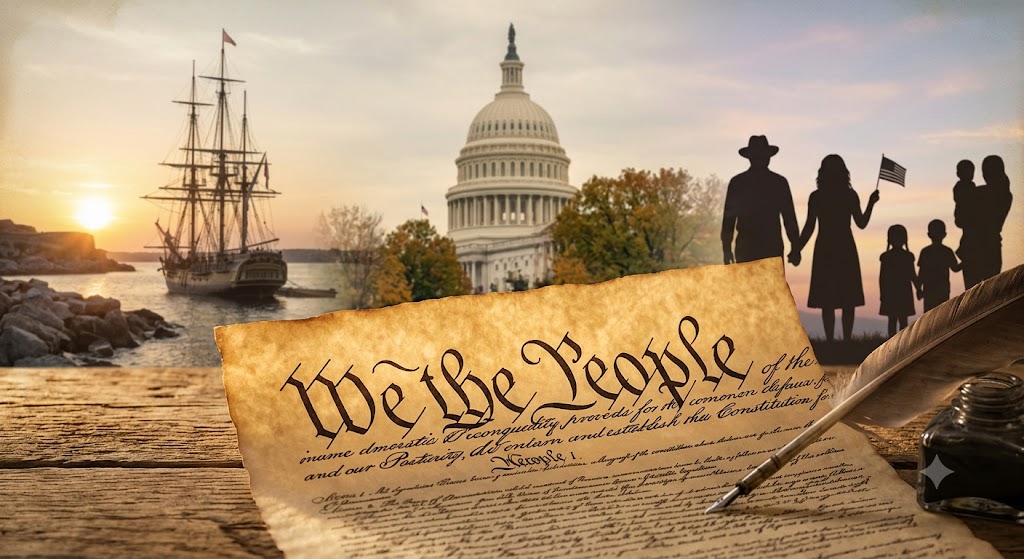
Keith returns for this solo episode, presenting another installment to celebrate America’s 250th birthday. Retrobot David helps present the following notes, while Keith expands a little bit on them. We try to stick to our 40 minute plan, but go over slightly. If you enjoy this type of format and topic for an occasional installment on the podcast, feel free to leave a remark in the comments or send an email.
“If you tried to read a comprehensive history of the United States, it would take you months, if not years. But today, we are going to do something audacious: we are going to cover over 400 years of history in just 40 minutes. To do that, we can’t just look at a random list of dates and battles. Instead, we have to look at American history as a continuous, unfolding story. And every great story is driven by a core conflict.”
“The core conflict of America lies in a single, powerful sentence written in 1776: ‘We hold these truths to be self-evident, that all men are created equal.’ When those words were written, they were an idealized promise, not a reality. The story of America is the story of a nation constantly wrestling with that promise. It is a messy, dramatic, and often violent struggle to define who gets to be included in the phrase, ‘We the People.'”
“Today, we are going to fly through this story in five major acts:
1. Act I: How a disparate group of colonies united to fight an empire.
2. Act II: How the nation nearly tore itself apart over the sin of slavery.
3. Act III: How America transformed from a rural farming nation into an industrial superpower.
4. Act IV: How we survived the darkest economic collapse in modern history and fought a global war.
5. Act V: And finally, how the Cold War and the fight for Civil Rights shaped the modern world we live in today.
Fasten your seatbelts. Let’s start in the year 1607…”
1. Foundations & Revolution (1607–1789)
- The Thirteen Colonies: Settled primarily by the British, the colonies developed distinct regional identities: the puritanical, merchant-driven New England and the agrarian, plantation-driven South.
- The Spark of Rebellion: Following the French and Indian War, Britain imposed taxes on the colonies to pay off war debts (e.g., Stamp Act, Tea Act). Lacking representation in Parliament, colonists resisted under the banner: “No taxation without representation.”
- The Turning Point: The Declaration of Independence (1776) framed the war not just as a geopolitical rebellion, but as a fight for universal human rights (“Life, Liberty, and the pursuit of Happiness”).
- A New Framework: After winning independence, the loose alliance under the Articles of Confederation proved too weak. In 1787, the U.S. Constitution was drafted, establishing a federal republic with a system of checks and balances, soon supplemented by the Bill of Rights.
2. Expansion, Division, & Civil War (1789–1865)
- Westward Expansion: The young nation rapidly expanded its borders through the Louisiana Purchase (1803) and the concept of Manifest Destiny—the belief that the U.S. was divinely ordained to expand across the continent. This came at a massive cost to Native American populations via forced removals like the Trail of Tears.
- The Looming Crisis: As new states joined the Union, a fierce political battle raged over whether they would allow slavery. The economic divide deepened: the North industrialized, while the South’s economy relied entirely on enslaved labor.
- The Breaking Point: The election of Abraham Lincoln in 1860 prompted Southern states to secede, forming the Confederacy.
- The Civil War (1861–1865): The bloodiest conflict in U.S. history. Lincoln pivoted the war’s purpose from simply preserving the Union to abolishing slavery with the Emancipation Proclamation (1863). The Union victory preserved the nation and ended legal chattel slavery via the 13th Amendment.
3. Industrialization, Empire, & Reform (1865–1919)
- The Gilded Age: The late 19th century saw massive industrial growth, the rise of monopolies (Rockefeller, Carnegie), and the rapid expansion of railroads. Cities boomed due to an influx of millions of European immigrants.
- The Progressive Era: In response to corporate greed, unsafe working conditions, and political corruption, the Progressive movement championed reforms, including labor laws, women’s suffrage (19th Amendment), and early environmental conservation.
- Emerging on the World Stage: The U.S. began looking beyond its borders, acquiring territories like Hawaii, Puerto Rico, and the Philippines.
- World War I: Breaking its traditional isolationism, the U.S. entered the war in 1917. American entry tipped the scales for the Allies, cementing the nation’s status as a rising global superpower.
4. Boom, Bust, & World War II (1920–1945)
- The Roaring Twenties: A decade of cultural shift, jazz, consumer boom, and economic prosperity—which came to a crashing halt.
- The Great Depression (1929): The stock market crash triggered a decade-long economic catastrophe. President Franklin D. Roosevelt (FDR) countered with the New Deal, fundamentally expanding the role of the federal government in the economy through social safety nets (like Social Security).
- World War II: The surprise attack on Pearl Harbor (December 7, 1941) pulled a reluctant U.S. into the global conflict.
- The Arsenal of Democracy: The war effort completely revitalized the U.S. economy. The conflict culminated in the atomic bombings of Hiroshima and Nagasaki in 1945. The war left Europe devastated, leaving the U.S. and the Soviet Union as the world’s two undisputed superpowers.
- The Cold War: A decades-long geopolitical, ideological, and economic standoff between the capitalist U.S. and the communist Soviet Union. It resulted in proxy wars (Korea, Vietnam), the nuclear arms race, and the Space Race.
- The Civil Rights Movement: Domestically, the 1950s and 60s saw a massive, courageous struggle for racial equality led by figures like Martin Luther King Jr. This led to landmark legislation like the Civil Rights Act of 1964 and the Voting Rights Act of 1965.
- The Turn of the Century: The collapse of the Soviet Union in 1991 left the U.S. as the sole global superpower. The focus shifted heavily toward globalization, the digital revolution, and, following the September 11 attacks (2001), the “War on Terror.”
- Today’s America: The modern landscape is defined by intense political polarization, ongoing debates over social equity, the rapid evolution of technology, and navigating a multi-polar global economy.
5. The Cold War & The Modern Era (1945–Present)
Podcast: Play in new window | Download (Duration: 48:22 — 44.3MB)
Subscribe: Apple Podcasts | Amazon Music | Podchaser | RSS | More