
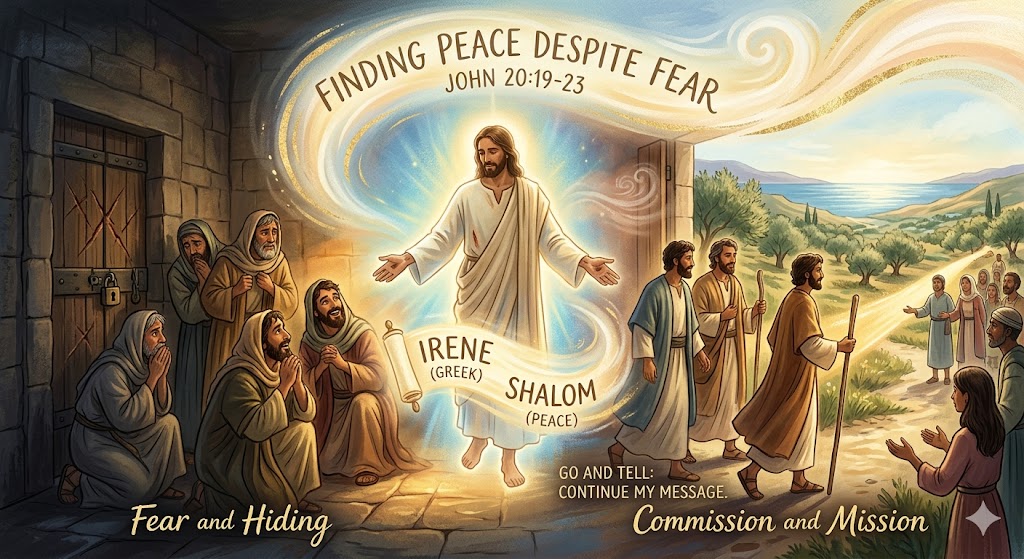
The Resurrection
The appearance to the disciples (John 20:19-23)
It was evening. It was still on that same day, the first day of the week. The doors are locked. The disciples are hiding in fear of the Jewish leaders.
Suddenly, Jesus was there. John doesn’t say that he walked through walls. John doesn’t say he walked through a door. Jesus was just there. They didn’t expect him. They were not looking for him. He was just there telling them not to be afraid.
John doesn’t talk about travelers on the road to Amoz, as Luke does.
Possibly the disciples were simply planning on how to get out of the city unnoticed, so they can meet with Jesus in Galilee.
That was the instruction that the women from the tomb gave to them, to meet him in Galilee.
The disciples would rightly be fearful, especially after their close call in the garden of Gethsemane the night before.
The sole purpose of this visit seems to be to relieve fears. Also to prove his identity when Jesus shows them his wounds.
Whether Jesus entered the room by natural or supernatural means, he was not impeded by locked doors.
The resurrection body has properties different from the body of flesh.
Yet it’s not so different either. His glorified body is still a physical body that contained scars from his wounds.
It was him! He was alive!
They were overjoyed, not only to see him again, but also to realize that he was undefeated by death and that his claims were validated.
Jesus repeated his greeting of peace. In Greek: Irene. In Hebrew: shalom.
Now that Jesus had the disciples settled down, he had a mission for them.
Just as God had sent him, he is sending them.
They were to continue reaching the lost sheep of Israel, and beyond.
He expected them to deliver his message (John 15:27),
to do greater works than he had done (John 14:12),
and to give their lives in his service.
They would have all the privileges, all the protection, and all the responsibilities that he had during his ministry.
A difficult saying: he breathed on them. This phrase appears nowhere else in Scripture. Was he giving them his Holy Spirit now? What about the coming of the Holy Spirit at Pentecost as recorded in Acts 2? Is there only one giving of the Holy Spirit, or is there to?
We present a Bible challenge to help explain this concept.
23 “If you forgive the sins of any, their sins have been forgiven them; if you retain the sins of any, they have been retained.”
In this statement, Jesus authorizes his disciples to forgive sins.
The Expositor’s Bible Commentary suggests that the giving of the spirit, and forgiving sins are linked together.
It’s the beginning, or being ordained, for a new ministry for his apostles.
The fulfillment will come at Pentecost when the spirit comes in full force.
It would be there (at Pentecost) that Peter would preach to repent and be baptized (acts 2:38).
EBC: The commission to forgive sins is phrased in an unusual construction.
Literally, it is: “Those whose sins you forgive have already been forgiven; those whose sins you do not forgive have not been forgiven.” The first verbs in the two clauses are aorists, which imply the action of an instant; the second verbs are perfects, which imply an abiding state that began before the action of the first verbs.
God does not forgive men’s sins because we decide to do so nor withhold forgiveness because we will not grant it.
We announce it; we do not create it.
This is the essence of salvation.
Two proclaim the gospel itself is all about forgiving sins.
It’s up to the hearer to accept the forgiveness of the gospel, or reject it.
Podcast: Play in new window | Download (Duration: 1:02:51 — 57.5MB)
Subscribe: Apple Podcasts | Amazon Music | Podchaser | RSS | More